
Part One · New Inverness
“We are informed that our neighbours of Savannah have petitioned for the liberty of having slaves. We hope and earnestly entreat that before such a permission is granted, your Excellency will consider our situation.”
Petition of the Highlanders of New Inverness to General James Oglethorpe, January 3, 1739
Chapters One and Two · about 20 minutes
Chapter One
Slack Water
The tide turned at 4:52 in the morning and for fourteen minutes the Altamaha did not move at all.
It happened twice a day and nobody had ever come out to see it. There was nothing to see. The river simply arrived at the end of its argument with the ocean and stopped, and for a little while the water in the delta lay flat and unmoving as a poured floor, holding the dark, holding the stars, holding a hundred thousand acres of cordgrass upside down. Then it began to run the other way, and the whole enormous machine reversed itself, and no one had to be told.
Arthur Alexander was awake for it, the way he had been awake for it most mornings of his life, though he could not have said what time it was and would have been unimpressed to learn. He stood on the wrap-around porch with a cup of coffee he had made too strong and looked out over the marsh at a landscape that had not consulted anyone about anything.
Out there in the middle of it, black against a sky going the color of a dead television, stood a brick chimney forty feet high.
It was the last piece of Butler Island. Everything else had gone—the mill, the barns, the tidal gates, the rows of cabins, the nine hundred people who had been made to build all of it and made to keep it running and then, in 1859, taken up to Savannah and sold in two days to cover a man’s card debts. What was left was a smokestack in the marsh holding up nothing, with egrets sleeping on the rim of it as though it had been put there for that purpose.
Alex had looked at it every morning for sixty-one years. His father had looked at it. His grandfather had looked at it and had, in all likelihood, known the names of men who had worked under it. It was simply the thing you looked at while you drank your coffee, in the way that people who live near a mountain do not spend much time discussing the mountain.
He finished the cup, threw the last inch into the azaleas, and went to work.
The docks were already going.
There was a particular sound the fleet made before daylight and Alex could have picked it out of any other sound on earth: the gravel-slide rattle of crushed ice going down the chute into a hold, forty pounds at a time, ten thousand pounds to a boat. Under that, generators. Under that, the low irregular knocking of men doing physical work in the dark and not talking much about it.
A dozen trawlers lay along the Darien River with their outriggers raked up at forty-five degrees, so that the whole fleet in silhouette looked like a line of moths at rest. They were not pretty boats. Alex had heard tourists call them picturesque, standing up on the bluff with their phones out, and he understood what they meant and thought they were wrong. They were handsome the way a good tool is handsome. Steel and wood and forty years of compromise. Hand-lettered transoms. Hulls streaked rust-orange from the scuppers down, where the paint had finally quit arguing.
Miss Rosalie. Second Chance. Penance—that last one belonging to a man named Dewey Sears, who had never once explained it and had been asked a great deal.
There were gaps in the line.
That was the thing you noticed if you had been looking at this river your whole life, and the thing you would not notice at all if you had not. Empty slips. Nine of them between the icehouse and the turn, where in 1998 there had been none. And down at the end, half-swamped and listing against her lines, a boat called the Ruthie Mae with cordgrass growing up through her deck drains, because nobody had come for her in two years and nobody was going to, and the county was not going to pay to haul her out, and so she was going to keep sinking in increments, in public, in front of everybody, for as long as it took.
Alex walked past her without turning his head. He had known Ruthie Mae. She had taught him fourth grade.
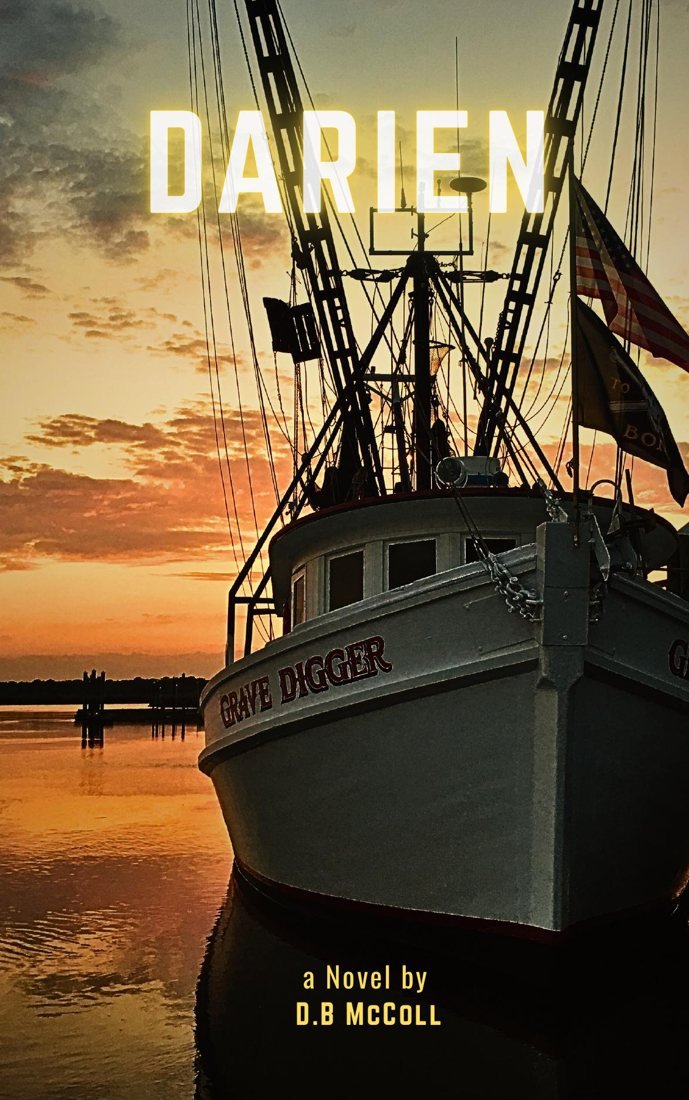
The Grave Digger stood out because she was clean.
Not new. She had been laid down in 1971 in a yard in Bayou La Batre, Alabama, and every one of the years since was visible on her if you knew where to look—the weld scars along the port rail, the patch under the wheelhouse where a piling had taken a bite out of her in a hurricane whose name Alex refused to say out loud. But somebody scrubbed her. The white was actually white. The brightwork had been touched with a rag inside the last week. In a fleet where the general standard was does it float and will it pull, the Digger looked like a woman who dressed for church whether or not anybody was going to be there.
His father had been that way. His grandfather, who built her, had been worse.
Alex came up the plank without looking at his feet. His feet had the gunwale memorized. Aft, Max and Shawn were bent over the try net, checking mesh with their thumbs the way you would check a shirt for a torn seam, and Max was singing something under his breath that Alex did not recognize and assumed was his own.
“Morning,” Alex said.
“Morning, Cap.”
He stirred his second cup of coffee with his index finger, tapped it once against the rail, and kept walking.
The helicopters came in low out of the west and you felt them before you heard them.
That was always the order of it. Something in the chest first, a pressure, the way a bass note comes up through a floor—and then, half a second behind, the sound arriving to explain itself. Every man on the dock stopped what he was doing and looked up, and every man on the dock would have denied doing so.
Three Blackhawks, in trail, riding the river.
Fort Stewart put them over the delta four or five days a week and had for as long as anyone could remember, and the fleet had a comfortable relationship with the fact. They were loud, and they were free, and once in a great while when a boat went down in weather it was one of those that came out and got somebody’s son off a hull. So the fleet forgave them the noise. That was the arrangement. Nobody had written it down.
Shawn had his hand up over his eyes. “Lead’s low.”
“Lead’s showing off,” Alex said.
Two hundred feet up and closing, Major Samantha Alexander saw her grandfather’s boat come out of the slip below her and made a decision she did not run past anybody.
She did not announce it on the interflight. She did not ask Emerson, who was riding the left seat and watching the delta unspool with the expression of a man who could not quite believe somebody paid him for this. She simply put in a little left pedal and a little forward cyclic and brought the aircraft down out of the pattern, and the marsh came up underneath them and turned into individual blades of grass, and the Grave Digger filled the chin bubble.
She ran the length of the boat at a hundred and forty knots and two hundred feet.
Down on the bow a figure straightened, saw what was coming, and put both arms over his head, waving like a man trying to stop a train. Sam smiled inside the helmet where no one could see it and touched two fingers to the brow of it, and then they were past, and climbing, and the marsh flattened back out into a map of itself.
It cost fifteen seconds and four hundred dollars of the taxpayers’ money and she would have done it again.
“Hey, Major.” Emerson’s voice in the headset, cheerful, over the interflight. “That’s home base, right? Darien. And I’ll bet that was your daddy’s boat.”
“That was the Grave Digger.” The tree line came up and swallowed the river behind them. “Actually it was my grandfather’s boat. She’s a beauty.”
“Yes, ma’am.”
“If you think shrimp boats are beautiful.”
Emerson laughed and gave her a thumbs up, and Sam turned north onto the heading and let the aircraft settle, and did not think—because it had never once occurred to her to think it, and would not for some months yet—that the name of the town falling away behind her had been carried across an ocean by people who had lost everything, and given to a strip of mud on a river by way of memorial to a catastrophe, and that her family had been the ones to carry it.
Behind them the tide, which had made up its mind, began to run out toward the sea and take the whole delta with it.
Chapter Two
New Inverness, January 1736
They were nine days coming down from Savannah in open boats, and it rained on six of them.
Hugh Alexander was twenty-three years old and had spent thirteen weeks on the Prince of Wales between Inverness and the Georgia coast, and he had believed, with the confidence of a man who has been badly seasick, that the worst of the journey was behind him. Then Captain Dunbar put them into periaguas at Savannah and pointed south, and they went down the inside passage between the islands with the water the color of weak tea and the banks pressing close on both sides, and Hugh discovered that there was a species of misery available to a man that had nothing whatever to do with the sea.
It was the closeness of it. That was what he could not get used to. In Strathnairn a man could see weather coming for half a day. Here the world was six feet on either side of the boat and the rest was leaves.
On the ninth day they came out of a creek into a wide brown river running strong, and the boats turned upstream, and somebody in the second periagua began to sing. It was not a good song for the occasion. It was a song about a place in Inverness-shire that most of them would not see again, and after four lines it stopped, because nobody would take it up.
Ahead of them on the north bank was a bluff twenty feet high with the timber cleared off the top of it.
The clearing was not new. That was the first thing Hugh understood and the thing that took him longest to put words to.
Somebody had been here. There were the rotted stubs of a palisade going in a rough square, and the black rectangle of a burned-out building at the center of it, and the ground was not forest floor but hard-packed dirt with weeds coming up through it in the disorderly way that weeds come up through a floor and not through a field.
And along the eastern edge, in three uneven rows, were the graves.
Nobody had to explain them. There were wooden markers over some, gone silver and soft, and over most there was nothing but a settling in the ground and a difference in the weeds. Hugh counted forty before he stopped counting, because Lieutenant Mackay had come up beside him and was watching him count.
“His Majesty’s Independent Company,” Mackay said. “They put a fort here in the year twenty-one. Held it six years.”
“And then?”
“And then they did not.”
Hugh looked at the rows. “Was it the Spanish?”
“It was the summer,” Mackay said, and walked away to see about the boats.
Later, from a man named Cuthbert who had it from a sailor in Savannah, Hugh got the rest of it: that the fort had been called King George, and that of two hundred-odd men sent to hold it, something on the order of a hundred and forty had gone into that ground, and that not one of them had been killed by anything you could fight. There had been a fever that came up out of the marsh with the heat. There had been the flux. There had been men who simply lay down in a place where nothing was familiar and did not get up.
The Highlanders made camp that night inside the rotted palisade because it was the only cleared ground, which meant that they slept forty feet from the graves, which meant that the graves became ordinary within about a week. That was the thing about it, Hugh would think much later, when he was an old man and had buried people of his own in the same soil. You could not sustain awe. The ground had killed a hundred and forty soldiers of the Crown and it was also the only flat place to put a cook fire, and by the second night men were putting their cook fires there.
There were a hundred and seventy-seven of them, counting the women and the children.
They had been recruited out of Inverness-shire in the autumn by two officers with a paper commission and a great deal to say about opportunity, and every man of fighting age among them had come off the boat with a broadsword, a targe, a plaid, and a musket, because that had been a condition of the arrangement and because they would not have come otherwise. They were mostly Mackays and Mackintoshes and Macbeans and Cuthberts, with a scattering of others. Hugh Alexander was one of the scattering. They spoke Gaelic among themselves and English when they had to, and there were four or five who had no English at all and would die with none.
Their leader was John Mohr McIntosh, a big man in every direction, who had been out in the year fifteen and taken prisoner for it and shipped to the Carolinas and come home again, and who therefore understood better than anybody in the party what it meant to be given land by a government.
What it meant was that the government wanted something standing in a particular place.
Hugh worked this out slowly over the first fortnight, and was not offended by it, and noticed that nobody else was either. To the south, past the mouth of this river and past the islands, was Spanish Florida, and in Florida was St. Augustine, and in St. Augustine were soldiers and priests and a standing offer of freedom to any enslaved person who could get there from the English colonies. Between St. Augustine and Savannah there was nothing. Savannah had money in it, and a printing press, and gentlemen.
So Savannah had bought a hundred and thirty armed Highlanders and set them on the far bank of the last river, and had not been coy about why.
“We are a wall,” said a man named Dougal Macbean, on the third day, hauling palmetto. “That is the whole of it. They are building a wall and they have found a wall that will feed itself.”
“A wall is a fine thing to be,” said John Mohr, who had heard him. “So long as you are the wall and not the mortar.”
There was general laughter, and they went on hauling, and the distinction did not seem as fine then as it would to their grandchildren.
The forest behind the bluff was the part Hugh never stopped trying to describe in letters, and never once got right.
He had expected—everyone had expected—something like the Great Wood of Caledon out of the old stories, close and dark and full of wolves. What was actually there was a room.
The pines went up eighty and a hundred and a hundred and twenty feet before they put out a branch, straight as a plumb line, with bark in plates like a fish’s scales, and they stood far enough apart that a man on a horse could ride through them at a trot in any direction he chose. There was no undergrowth. There was grass—a fine, wiry, knee-high grass that ran unbroken between the trunks for as far as a man could see, which on flat ground and in that light was a quarter of a mile and sometimes further. The lower six feet of every trunk was scorched black. It took Hugh a season to understand that the forest burned regularly and was supposed to, and that the burning was what kept the floor open, and that the Indians had been setting those fires deliberately for longer than anyone could tell him.
In the mornings the light came through it level and gold and the whole thing looked less like a wood than like the inside of a kirk built by somebody with unlimited money and no interest in walls.
There were birds in it he had no words for. Small green ones, parrots by every appearance, in flocks of forty and fifty, screaming, which was a thing he could not make sit alongside the frost on the grass in February. There were woodpeckers the size of a duck with bills like ivory chisels, and they made a noise like somebody knocking politely on a door far off, and they went unhurriedly away from you when you came near, which he took as a sign that they had not yet learned to be afraid of anything.
Three hundred years later there would be a highway through that ground and a mill and a subdivision and a Dollar General, and the grass would be gone and the fire would be gone and the parrots would be extinct to the last bird and the woodpeckers with them, and the pines that came back would be a different pine altogether, planted in rows, harvested in thirty years, dense as a hedge and dark as a cellar. And people who had been born here would stand at the edge of it and call it the woods, and mean it, and be certain that this at least was the one thing about the place that had never changed.
The Altamaha did a thing Hugh did not believe for three days.
It rose and fell twice a day, six feet or better, and it was fresh. He knelt on the bank the first morning and put his hand in and brought it to his mouth expecting salt, and there was none, and he did it again in the afternoon when the water had come up over the mud he had knelt on, and there was still none. A river that has a tide is a river that has met the sea. This one had a tide and had somehow declined the rest of the transaction.
Out in front of the bluff the river split and split again around a set of low islands, and those islands were not marsh. They were swamp forest—cypress standing in black water with their knees up around them, and tupelo, and a canopy so thick that at midday underneath it you needed to be told it was midday. Snakes. Alligators, which Hugh had not been warned about by anyone and about which he formed a permanent and unreasonable opinion within his first month.
Nobody in the party looked at those islands and saw anything but an obstacle.
Fifty-five years later a man from Charleston would look at the same islands and see that a tidal freshwater river running six feet twice a day is the finest engine for irrigating rice that God ever put on the North American continent, and would begin to buy. And other men would buy. And between them they would put several thousand enslaved people into that swamp with axes and shovels, and those people would cut the cypress out of it and grub the stumps and throw up embankments four feet high and eight feet through and dig canals in a grid so exact that it could be seen from the air, though there was as yet nobody to see it from the air. They would build gates in the embankments to let the tide in and hold it and let it out again. They would make of that swamp a machine, and the machine would run for seventy years on people, and then the war would come and it would stop, and the river would begin—patiently, twice a day, without any opinion in the matter —to take it back.
What would grow up in it was cordgrass.
And in time it would be so beautiful, and so apparently ancient, that a woman flying two hundred feet over it in a helicopter would take it for the oldest thing in Georgia.
Oglethorpe came down in February.
He came without ceremony and with about a dozen men, and he had put himself into Highland dress to do it—plaid, bonnet, the whole apparatus, badly worn as a man wears clothing he has not grown up in. Hugh, who by that point had been sleeping on the ground for five weeks and had opinions about ceremony, expected to find it ridiculous.
He did not find it ridiculous. That was the first political education of his life, and he never afterward forgot the lesson, which was that a gesture does not have to be sincere to be effective and that the two questions are not related.
The General walked the ground with John Mohr. He looked at the palisade and the huts of palmetto thatch and the guardhouse they had raised and the twelve-foot boat they were building. He said the words that men in his position say. He noted, and did not dwell on, the fact that the Spanish considered this river to be a hundred miles inside their own territory, and that the Creek considered it a line agreed upon and not a gift, and that the settlement was therefore where it was for reasons that had nothing whatever to do with the quality of the soil.
Then somebody raised the question of what the place was to be called.
New Inverness, it was agreed, for the town. That was straightforward, and half a dozen men said it at once with the particular satisfaction of people naming a thing after a place they have lost.
And then a man—Hugh could never afterward be certain who, though he would be asked about it for the rest of his life and would eventually settle on an answer for the sake of the asking —said that the district ought to be called Darien.
There was a silence of about four seconds.
Every grown man standing on that bluff knew what Darien was. Darien was the Isthmus, and the Company of Scotland, and the year ninety-eight, when the whole nation had emptied its pockets into a scheme to plant a colony in Panama and command the trade of two oceans. Widows had put in. Burghs had put in. Something on the order of a fifth of every coin in Scotland had gone into the holds of those ships. Twenty-five hundred people had sailed. Roughly two thousand had died—of fever, of hunger, of the astonishing incompetence of men who had brought wigs and combs and Bibles to trade with people who wanted none of them. The survivors came home to a bankrupt country, and eight years later that country signed away its parliament, and there were men on this bluff whose fathers had told them that the two facts were the same fact.
To name a settlement Darien was to name it Disaster. It was to stand on a mass grave in a place that had already killed everyone who tried it, with Spanish soldiers ninety miles south and a nation’s worth of ruin ninety years behind, and say the word out loud on purpose.
Nobody objected.
Hugh Alexander, twenty-three, understood in that moment something about the people he had come with that he would spend the next fifty years failing to explain to his children. They were not naming it out of grief. They were not naming it out of defiance either, though defiance was in it. They were naming it out of a kind of arithmetic. If a thing is going to be taken from you, you say its name first. You get out in front of it. You put the worst word you know on the door of the house, and then there is nothing left for anyone to come and tell you.
It was a way of being unable to be surprised. It was, Hugh would come to think, the only genuine inheritance any of them had.
He passed it to his son, who passed it on, and it went down through nine generations without ever once being said aloud, and it was still in the family in the twenty-first century, in a woman who could put a four-ton aircraft on a dime and could not say the word stay.
The graves took fifteen of them before the first summer was out.
They put them in the same three rows, because the ground was already broken there and because it seemed the decent thing, and by August there was no way to tell the new from the old except that the new ones had not settled yet.
Hugh Alexander was not among them. He lived another fifty-one years, and buried a wife and two children on that bluff, and married again, and took up land upriver, and fought the Spanish at Bloody Marsh in the year forty-two, and grew indigo without success and then rice with a great deal of it, and in January of 1775 he signed his name to a document that his descendants would frame and hang and quote and, for the most part, decline to read all the way through.
But that comes later.
In February of 1736 he was twenty-three years old and standing on a bluff over a river that ran two ways, in a forest like the inside of a kirk, forty feet from a hundred and forty English soldiers who had come here before him and stayed, listening to a man he could not afterward identify propose that they name the place after the worst thing that had ever happened to Scotland.
And he had thought, aye, that will do.
End of the free sample